

Rumi
Devotion · Love
Rumi
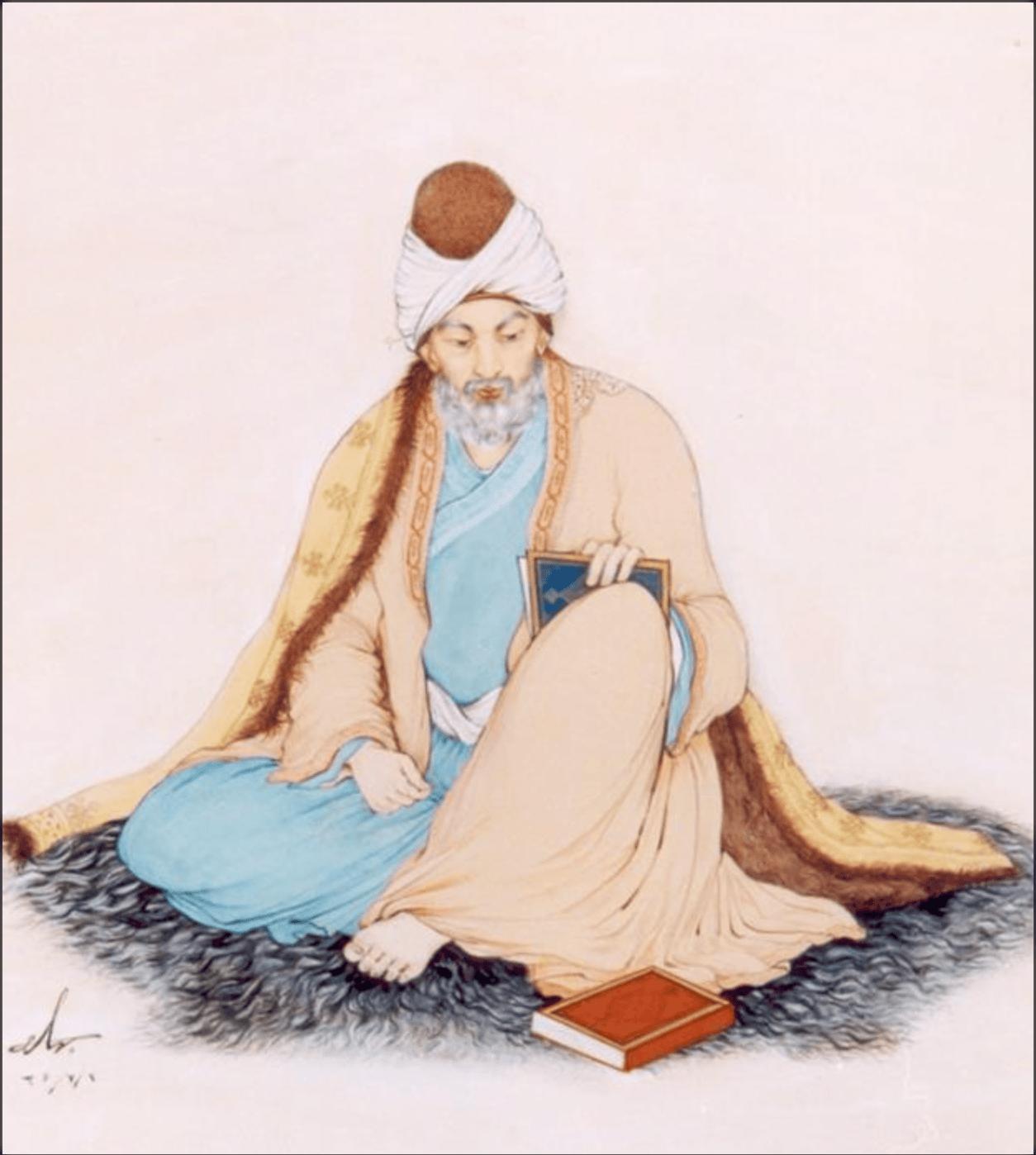
A Persian-language poet whose work invites a reading of love through spiritual transformation.
1207–1273 · Persian Sufi poet and mystic
Their literary world
Jalāl al-Dīn Rūmī is a major voice in Persian mystical poetry. His writing treats love as a force that can transform ordinary experience into a longing beyond familiar boundaries. The search of the lover becomes a way to speak about separation, the soul, and its source.
Rūmī moves between story, humour, instruction, and ecstatic image. In the Masnavi’s opening, the reed flute laments being cut from its reed-bed: music becomes the sound of separation. That image makes longing not merely a wound, but a voice that can disclose what ordinary explanation cannot hold.
Featured reading · Flute & Forge rendering
The Song of the Reed
Read the supplied Flute & Forge rendering of the reed’s opening song, then visit the source material for Rumi’s Persian Mas̱navī.
The reed speaks because it has been cut from its source. Its music becomes both wound and message: separation hurts, yet it gives longing a voice others may recognize. This opening invites us to hear the poem as a search for return, and for a listener able to hear beyond the sound.
The English text is a new Flute & Forge rendering, not a published translation. The reed prologue spans eighteen couplets.
Explore Rumi’s Persian text and sourcesA passage
“Listen to this reed how it complains:”Masnavi, Book I · translated by Reynold A. Nicholson (1926)
A way into the passage
In the opening, the reed’s lament begins with separation from its source. The flute gives longing a sound: breath passes through an emptied reed and turns absence into music.
Essential works
Masnavi, Book I · opening verses
The Song of the Reed
The reed flute’s lament introduces separation and the desire to return to a source.
Six-book narrative poem
Masnavi
A wide-ranging work of stories, parables, and spiritual reflection, composed in Persian couplets.
Lyric poetry collection
Dīvān-e Shams-e Tabrīzī
Lyric poems associated with love, ecstasy, and transformation, named for Rūmī’s beloved companion Shams.
A question worth exploring
Can longing become a way of understanding what we feel separated from?
A question to carry with you
What changes when love exceeds the story of two people?
An editorial introduction by Flute & Forge Studio.