

Gustav Klimt
Beauty · Love
Gustav Klimt
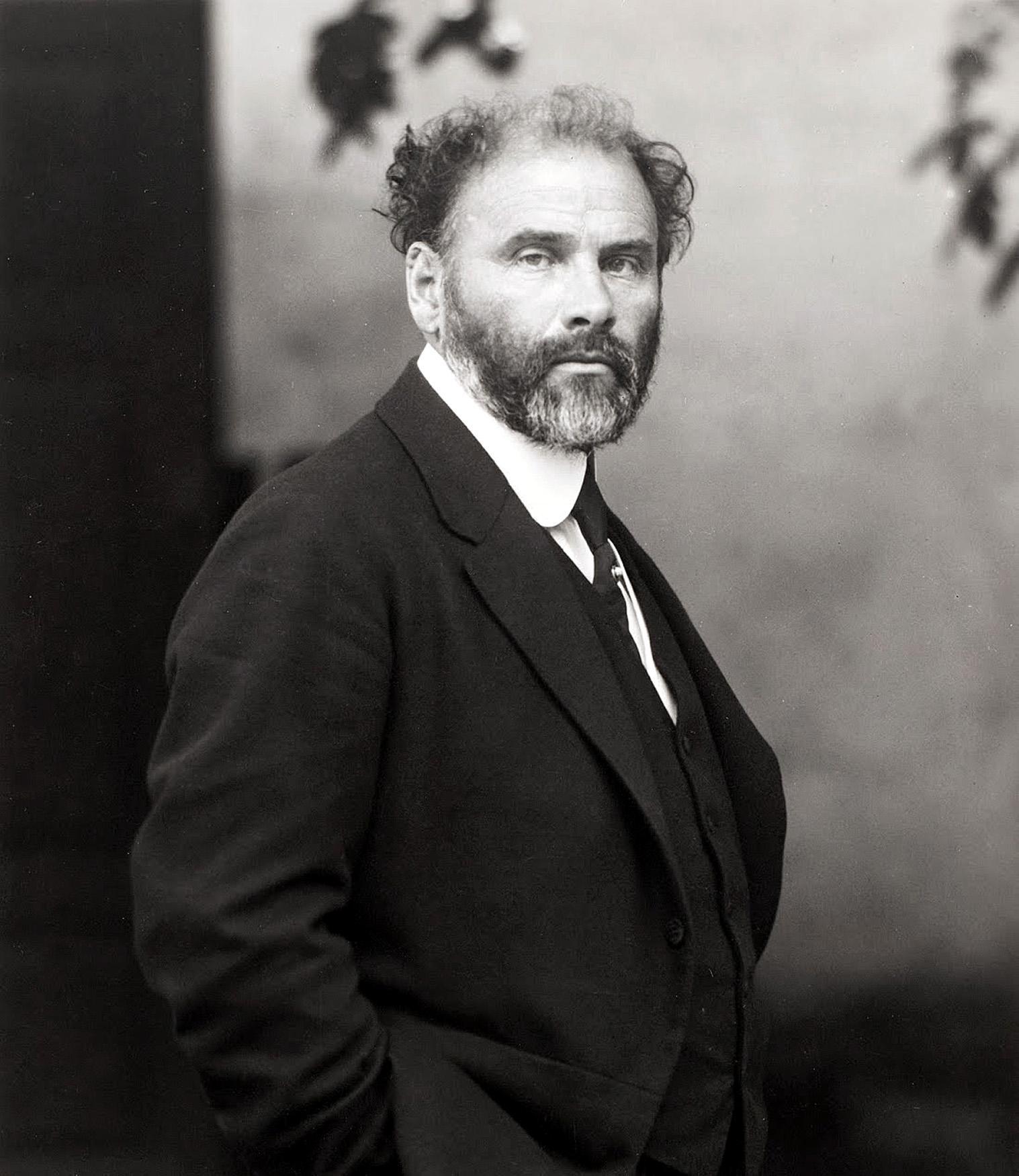
A painter whose decorative surfaces invite us to look at intimacy through pattern, colour and gold.
1862–1918 · Austrian Symbolist painter · Vienna Secession
Their literary world
Gustav Klimt made the human figure a meeting point for colour, ornament, sensuality, and emotional intensity. As a leading figure in the Vienna Secession, he challenged conventional boundaries and developed a distinctive visual language of bodies, patterns, and symbolic form.
In The Kiss, the lovers are enclosed by an ornate golden field, yet their robes retain distinct patterns. The painting invites a reading of intimacy as closeness that need not erase difference. Klimt’s imagery makes a wordless question visible: how can two people be held together and remain distinct?
Featured reading · Flute & Forge art encounter
The Kiss
A Flute & Forge visual reading considers how Klimt’s enveloping gold holds two figures close while their patterned garments remain distinct.
The embrace fills the canvas, but the patterned robes preserve difference inside closeness. Gold makes the moment seem outside ordinary time; the meadow edge quietly reminds us that the world continues around it. This is one way into the painting, not a claim about what Klimt intended.
This is an editorial interpretation, not a statement of Klimt’s intention. The Belvedere holds the painting; use its source page for the work.
Explore the Klimt collection at the BelvedereAn artwork
Two figures lean together within a single golden field, their patterns still distinct.The Kiss (Lovers) · 1907–1909 · Belvedere, Vienna
A way into the passage
The Belvedere describes the lovers as entwined, with different patterns distinguishing their robes. That contrast opens an editorial reading of union without complete sameness; it is a way into the image, not a claim about Klimt’s stated intention.
Essential works
Painting · 1907–1909
The Kiss (Lovers)
An intimate embrace framed by gold leaf and ornamental patterns, now in the Belvedere collection.
Painting · 1907
Portrait of Adele Bloch-Bauer I
A portrait in which a particular sitter’s identity meets an elaborate field of gold and pattern.
Painting · 1910–1915
Death and Life
A symbolic composition placing mortality beside the continuing movement of human life.
A question worth exploring
When two people come together in love, do they become one, or do their differences make the connection meaningful?
A question to carry with you
Where do two figures remain distinct within an embrace?
An editorial introduction by Flute & Forge Studio.