
Frida Kahlo
Longing · Beauty
Frida Kahlo
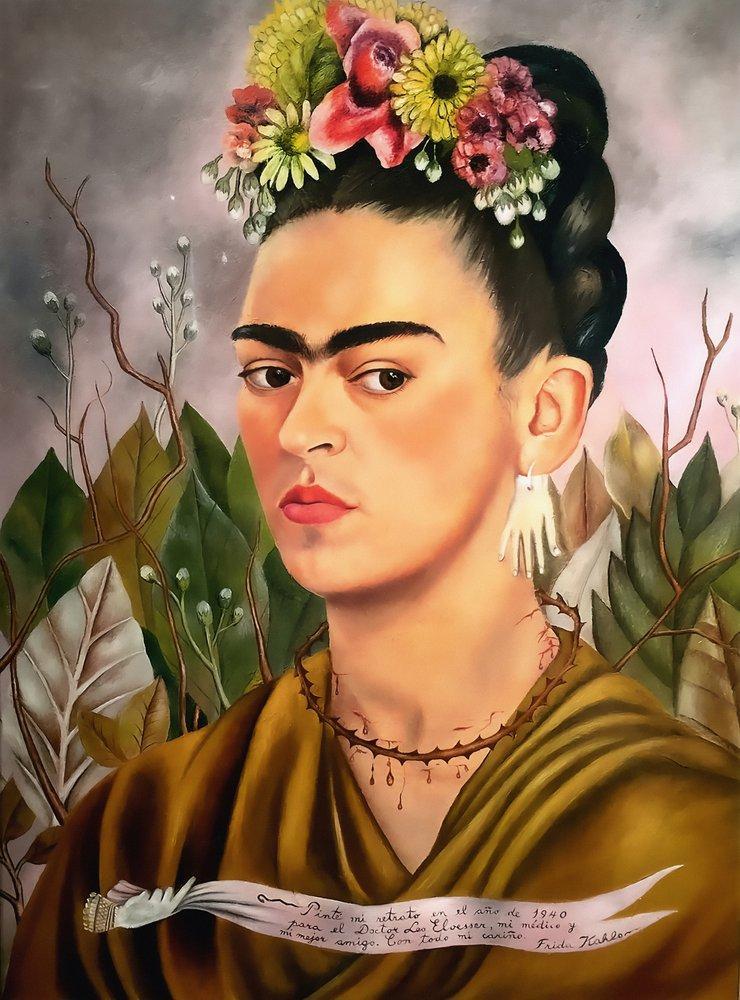
A painter whose self-portraits give visible form to identity, pain and the relationships around her.
1907–1954 · Mexican painter
Their literary world
Frida Kahlo turned lived experience into paintings about identity, relationships, the body, pain, and cultural belonging. Her self-portraits use symbolic imagery to make inner conflict, intimacy, separation, and the complexity of identity visible.
Her paintings make the body and emotional life difficult to separate: anatomy, landscape, animals, clothing, and objects carry feeling. Her practice also asserts creative independence. Art gives form to experiences that resist ordinary language, allowing affection, vulnerability, pain, and selfhood to coexist without collapsing into one emotion.
Featured reading · Flute & Forge art encounter
The Diary of Frida Kahlo and The Two Fridas
A Flute & Forge art encounter follows Kahlo’s self-image between the intimate diary and The Two Fridas. Look closely at the painting through its museum record.
Kahlo’s diary and double self-portrait invite us to consider identity as something lived through the body, memory and image. The two figures in the painting are connected but not interchangeable. This is an editorial encounter with the work; museum records and rights holders remain the authority for the image itself.
This is an editorial encounter, not Kahlo’s diary text. The linked museum page documents the artwork; reproduction rights remain with their holders.
Explore The Two Fridas in the MoMA exhibition recordA passage
“I love you and I always will.”Farewell letter to photographer Nickolas Muray · wording documented by Museo Frida Kahlo
A way into the passage
The museum places this statement in the context of Kahlo’s relationship and separation from Muray. It is best read as a personal expression of enduring affection, not as a universal maxim about love.
Essential works
Painting · 1939
The Two Fridas
Two versions of Kahlo sit together, linked by their exposed hearts; the painting explores divided identity and cultural belonging.
Painting · 1944
The Broken Column
A fractured column, nails, and exposed landscape give visual form to bodily suffering and vulnerability.
Painting · 1940
Self-Portrait with Thorn Necklace and Hummingbird
A symbolic self-portrait using animals, plant life, and bodily discomfort to complicate the image of the self.
A question worth exploring
Can making art change our relationship with pain without making the pain disappear?
A question to carry with you
What can a self-portrait reveal that a description cannot?
An editorial introduction by Flute & Forge Studio.Further exploration
Museum of Modern Art
Read at the source