

Mirza Ghalib
Longing · Consciousness
Mirza Ghalib
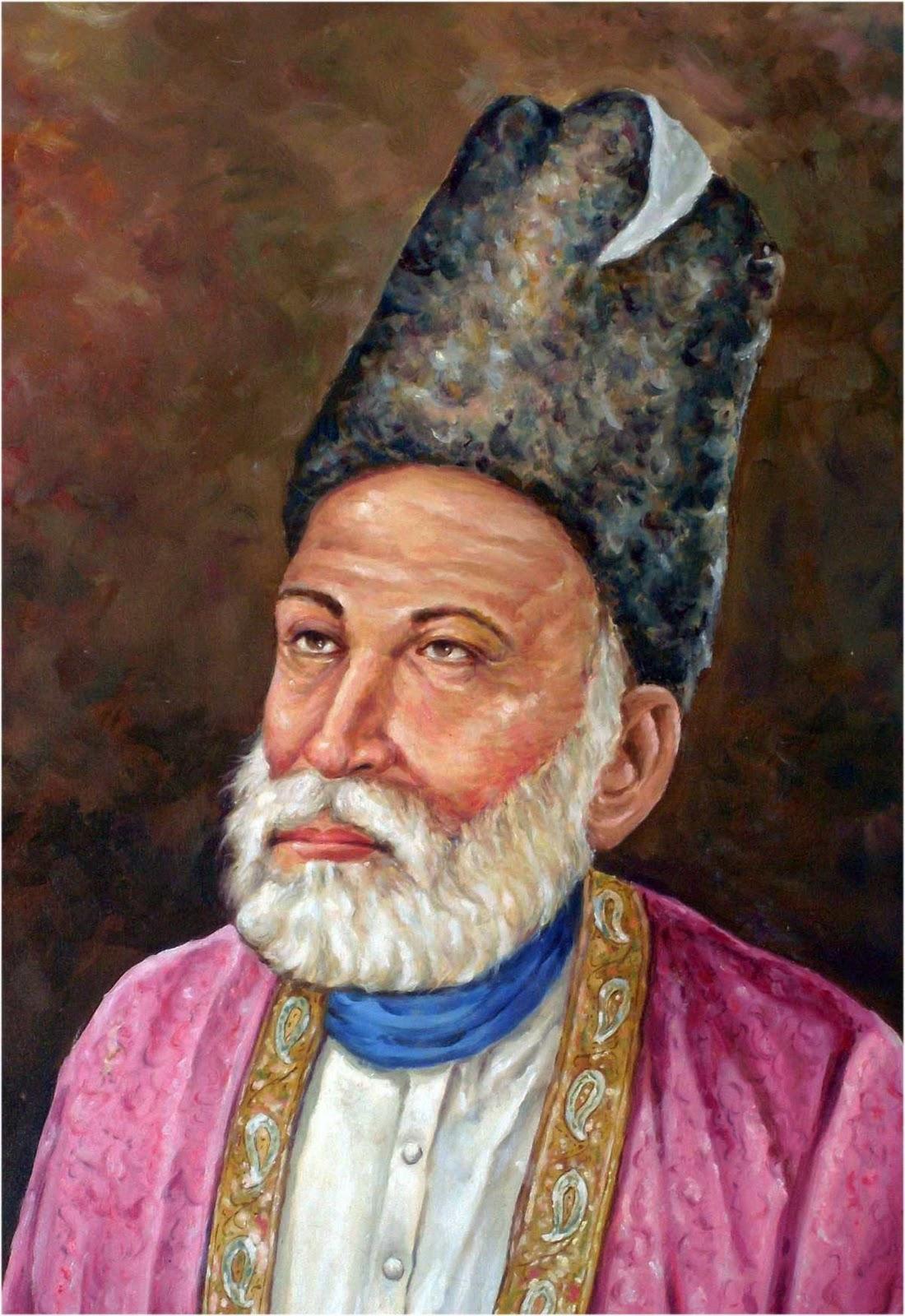
An Urdu and Persian poet whose questions can hold desire, irony and uncertainty in a single turn.
1797–1869 · Indian Urdu and Persian poet
Their literary world
Mirza Ghalib made longing one of Urdu poetry’s most intellectually alive experiences. His ghazals hold desire, loss, uncertainty, and wit together: hope may sustain us while keeping us unsatisfied, and the beloved may feel both intimate and unreachable.
His poetry questions certainty about faith, identity, and fulfilment, often with humour even in despair. Its compressed language lets contradictions remain unresolved. A couplet can make desire feel at once exhilarating and exhausting, leaving the reader inside the tension rather than offering an easy answer.
Featured reading · Flute & Forge rendering
Hazaron Khwahishen Aisi
Encounter Ghalib’s ghazal through the supplied Flute & Forge English rendering, alongside a source for the Urdu text.
A ghazal can hold incompatible feelings in adjacent couplets: desire and wit, pride and abasement, love as life and as a kind of dying. Read each couplet as its own turn in the argument, while hearing the repeated rhyme draw them into one unsettled voice.
This is an editorial rendering after Ghalib, not a line-by-line scholarly translation. The ghazal’s couplets also circulate in variant readings.
Explore the Urdu text at RekhtaA passage
“A thousand desires, each so intense it could take one’s breath away.”Hazāroñ ḳhvāhisheñ · opening couplet of a ghazal in Dīvān-e Ghālib
A way into the passage
This is an original editorial rendering of the opening hemistich. Ghalib captures desire as seemingly inexhaustible: fulfilment may not settle longing, because one wish can give way to another.
Essential works
Ghazal · Dīvān-e Ghālib
Hazāroñ ḳhvāhisheñ
A ghazal on the restless abundance of desire and the strange insufficiency of fulfilled wishes.
Ghazal · Dīvān-e Ghālib
Dil-e-Nādāñ Tujhe Huā Kyā Hai
A questioning address to the bewildered heart, moving through love, suffering, and self-understanding.
Ghazal · Dīvān-e Ghālib
Ye Na Thī Hamārī Qismat
A poem of disappointment and unattainable union, rendered with Ghalib’s characteristic complexity.
A question worth exploring
Is longing ever satisfied, or does wanting continually create itself anew?
A question to carry with you
Does fulfilling a desire quiet it, or make room for another?
An editorial introduction by Flute & Forge Studio.